







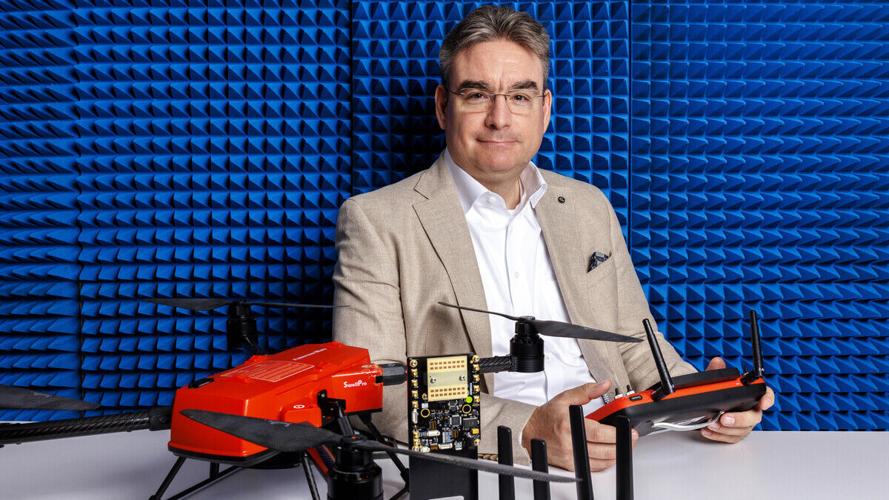
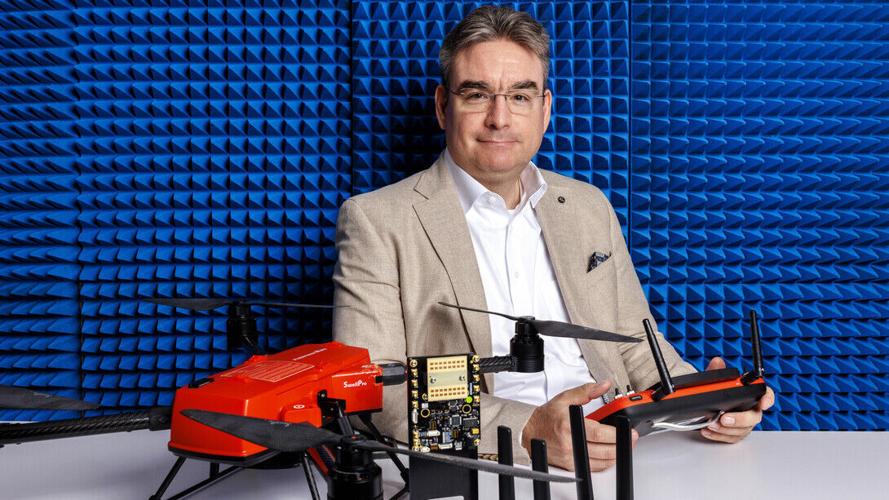
A University of Nebraska–Lincoln researcher is leading a team contributing to the U.S. Department of Energy’s Genesis Mission, an ambitious effort to build the world’s most powerful integrated science discovery platform.
Mehmet Can Vuran’s project was among the inaugural awardees announced July 22 at the Genesis Mission Summit in Washington, D.C. By uniting government, industry, academia and philanthropy, the mission is accelerating breakthroughs in energy, scientific discovery and national security through a new platform that combines artificial intelligence, supercomputing, quantum systems and advanced scientific instruments.
The program’s overarching goal is to harness AI to double the productivity and impact of American research and innovation. Vuran’s team was selected for a Phase I award, part of a category aimed at identifying promising pathways toward transformative scientific capabilities and establishing a foundation for future investment and scale.
People are also reading…
Project teams will design and demonstrate research workflows that integrate AI with scientific investigation while rigorously evaluating whether those approaches can accelerate discovery, improve predictive capabilities, enhance experimentation or generate new scientific insights.
“We are honored to represent Nebraska in the once-in-a-lifetime Genesis Mission, which is a critical step in securing U.S. leadership in the global 6G race and advancing the Department of Energy’s scientific mission,” said Vuran, Dale M. Jensen Chair and Professor of computing. “We are excited to collaborate with Brookhaven National Laboratory, ALPEMI Consulting LLC and Hewlett-Packard in this project.”
Vuran attended the summit to represent the team, which also includes Santosh Pitla, professor of biological systems engineering. In total, the Department of Energy selected 278 projects from a pool of applicants that represented the largest response to a funding opportunity in DOE history.
“This award highlights Nebraska’s leadership at the forefront of AI and 6G technologies, both of which are fundamentally reshaping how we conduct research and solve complex challenges,” said Jen Nelson, vice chancellor for research and innovation. “As a land-grant university, we are committed to developing real-world solutions for people in Nebraska and beyond. The Genesis Mission supports that goal by accelerating research and creating technologies with far-reaching benefits.”
The award also reflects the College of Engineering’s strength in AI and next-generation communications.
“As Nebraska’s only College of Engineering and leader in AI research, we have a strong foundation for guiding the state’s work in this rapidly emerging field,” said Lance C. Pérez, Fred Hunzeker Dean of Engineering. “Dr. Vuran is an outstanding faculty member, and his Genesis project reflects that strength. It is exactly the kind of groundbreaking research our engineering faculty conduct and that benefits Nebraskans while solving challenges of global importance.”
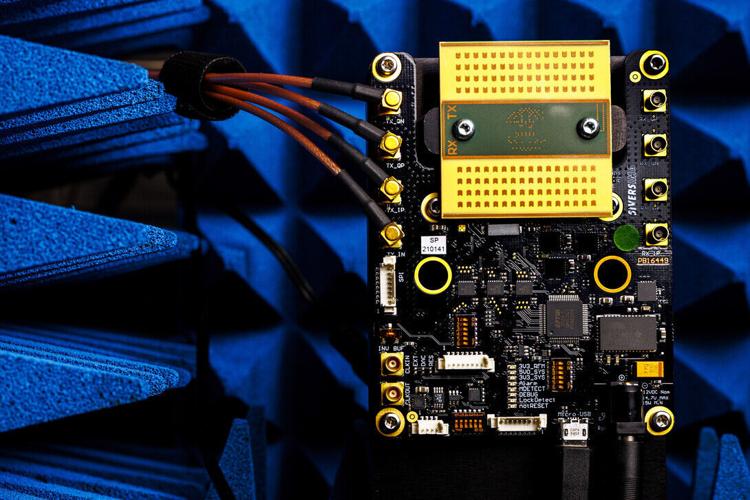
Vuran’s team will advance AI-driven co-design methodologies capable of designing, deploying, testing and evaluating 6G radio access networks — the portion of the cellular infrastructure that connects wireless devices like sensors, robots and drones to the broader communications system. Developing intelligent and flexible RAN is increasingly critical with the approaching launch of 6G networks, expected to happen globally around 2030.
In addition to featuring speeds at least 100 times faster than today’s technologies, 6G infrastructure will have AI and machine learning functions embedded within its networks — allowing them to process, interpret and optimize information. As the networks grow in complexity, traditional human-driven design approaches are insufficient to support rapid innovation, Vuran said.
To solve that problem, his team is developing an AI-driven co-designer that reduces 6G RAN design iterations from time frames of weeks and months to a matter of days. This ability to quickly modify 6G networks is key in the unpredictable real-world settings where future DOE scientific missions will take place.
“With the AI co-designer, we are building an ‘autopilot’ for designing the next generation of 6G wireless technology,” he said. “The designed solutions will ensure our future robots and sensors stay connected even when moving through unpredictable terrain.”
The system also addresses cost: To outfit each individual device with an AI-friendly graphics processing unit would be extremely expensive. In addition, GPUs consume significant power, generate heat and often are physically large. Under Vuran’s model, rather than install a costly GPU into every sensor or robot, the devices would collect data and send it to nearby, shared AI computers or high-performance computing centers through intelligent 6G RAN.
This would enable thousands of devices to leverage AI without having their own dedicated hardware.
“We are creating a novel, AI-driven system that acts like a ‘brain’ for the network,” Vuran said. “It can automatically reconfigure itself and move computing power to where it’s needed most, whether that’s on a robot, at a local tower or in a supercomputing facility.”
The Genesis award showcases the university’s expertise at the intersection of AI and 6G technology. Vuran oversees the Cyber-Physical Networking Lab at Nebraska, an international research hub dedicated to intelligent wireless networks. The lab hosts the Nebraska Experimental Testbed of Things, a citywide platform that enables researchers to test communications technologies in realistic environments.
Earlier this year, the College of Engineering launched the Pioneering Responsible AI for Research, Innovation and Education initiative, with the goal of thoughtfully integrating responsible AI across research, teaching and practice. PRAIRIE, led by Mark Stone, professor of biological systems engineering, is a national model for deploying AI responsibly in engineering education and research.
The University of Nebraska also recently established the Artificial Intelligence Institute, aimed at positioning Nebraska as a national leader in responsible, human-centered AI. Pitla and Adrian Wisnicki, professor of English at the University of Nebraska–Lincoln, co-direct the institute.


