


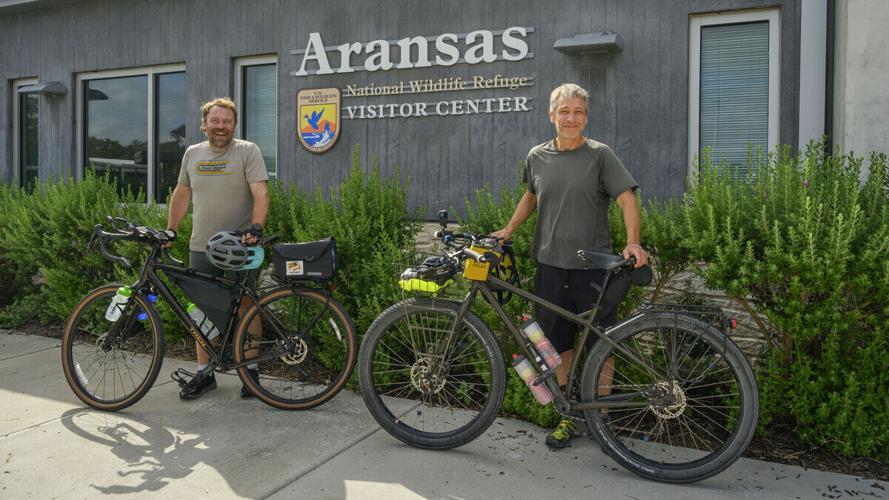
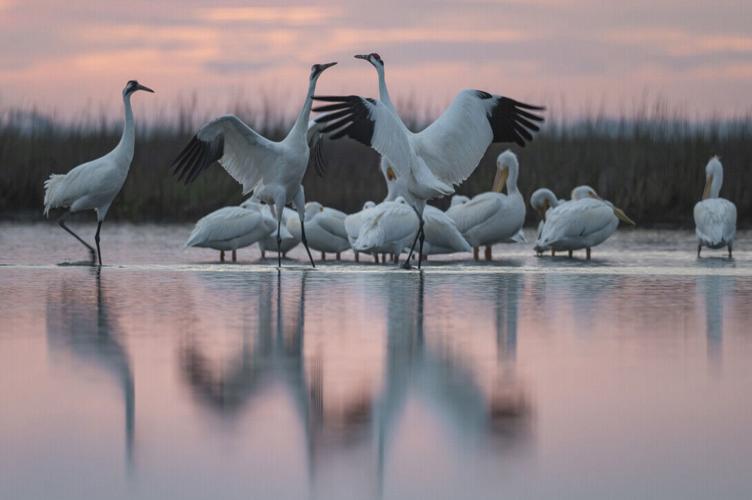
Each year, hundreds of whooping cranes migrate more than 2,500 miles from the Texas Gulf Coast to Canada’s boreal forest, following a path known as the Whooper Highway. Nebraska sits about halfway along the route. This year, two conservationists — one a Husker faculty member — are traveling the migration path on bicycles.
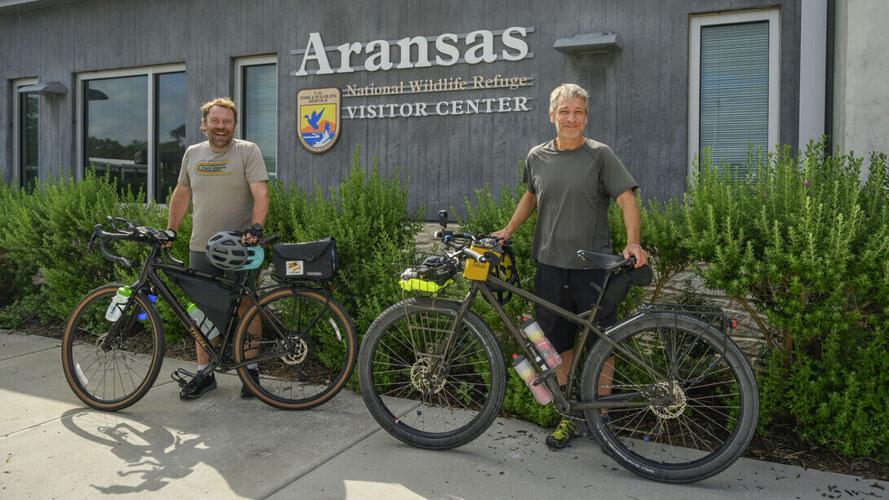
Michael Forsberg, a conservation photographer, founder of the Platte Basin Timelapse and research assistant professor in the university’s School of Natural Resources, and Andy Caven, director of central flyway programs at the International Crane Foundation, began their journey May 11. Averaging 65 miles per day, with 10 resting stops along the way, they plan to finish June 30 in the prairies of central Saskatchewan.
On June 5, Forsberg and Caven stopped at the Rowe Sanctuary Visitors Center in Gibbon, Nebraska, for a community conversation. Among the anecdotes they shared about the people they have met, the communities that have welcomed them, and the flora and fauna they have encountered — more than 150 species of birds and 300 species of plants identified so far — they talked about their goals for the ride.
People are also reading…
First is to not only highlight these rare birds, but also the habitat loss of the Great Plains migration path that stretches the entire length of the country and a significant portion of the North American continent. Currently, about 3,500 square miles of wetlands are lost every year along the Whooper Highway.
“For me, it’s a journey of discovery,” said Forsberg, who has been photographing the whooping crane for the past seven years. “You don’t necessarily know what you’re going to learn until you’re out there doing it. And then sometimes you’re not sure what you learned until you get to the endpoint and you look in the rearview mirror.”
Caven’s work focuses mostly on conservation policy for whooping cranes, sandhill cranes and their habitats.
Standing about 5 feet tall, with black and white plumage, whooping cranes are the rarest cranes in the world. They once dominated Midwestern skies but nearly went extinct in the 1940s when they were reduced to fewer than 20 wild birds. Today, they have grown to more than 800 but are still endangered and federally protected.
“The central flyway doesn’t have a lot of representatives, and whooping cranes are the ultimate umbrella species,” Caven said. “If we protect this space for whooping cranes, it’ll benefit a lot of other species in the central flyway.”
Forsberg and Caven’s second goal is to physically feel the distance the whooping cranes travel between nesting and wintering grounds, or to “feel the weight of migration,” Forsberg said. To do so, both men are riding manually powered bicycles — no electric motors or pedal assists.
“To be able to get on bikes and experience not just what you see, but what you hear, what you smell, even all the bugs that you eat, that is something that we wanted to try to experience,” Forsberg said.
At the same time, both men recognize their efforts pale in comparison to the birds’, citing that while they ride 65 miles per day, whooping cranes can fly 300 miles per day.
Despite the challenges and hard realizations they have encountered, they spoke about the hope the ride has given them. In one community, a group of cyclists rode a stretch of the road with them, which Forsberg and Caven affectionately dubbed their “flock.” In another, some senior citizens told them their history of growing up in the area and how much has changed over the years.
“We understand what’s at stake now,” Forsberg said. “The big question is, what do we want this place to be? Moving forward, how do we want to live our lives — not so much as what are we protecting something from, but who are we protecting something for? If we didn’t have hope, we wouldn’t be able to do what we do.”
Following the conversation, Forsberg and Caven led a new “flock” of about 25 local cyclists on a 26-mile ride to the Crane Trust Nature and Visitor Center in Wood River.
The men planned to make their next stop in either Pierre or Aberdeen, South Dakota, before riding into North Dakota and Canada.


