
Recent changes to federal financial aid regulations under the One Big Beautiful Bill Act (OBBBA) will impact federal student loans, Parent PLUS Loans, and Federal Pell Grant eligibility beginning July 1, 2026. Students and families should be aware of these updates as they plan for future semesters and complete the FAFSA process.
Below is an overview of the key changes and what they may mean for your financial aid eligibility.
Federal student loan changes
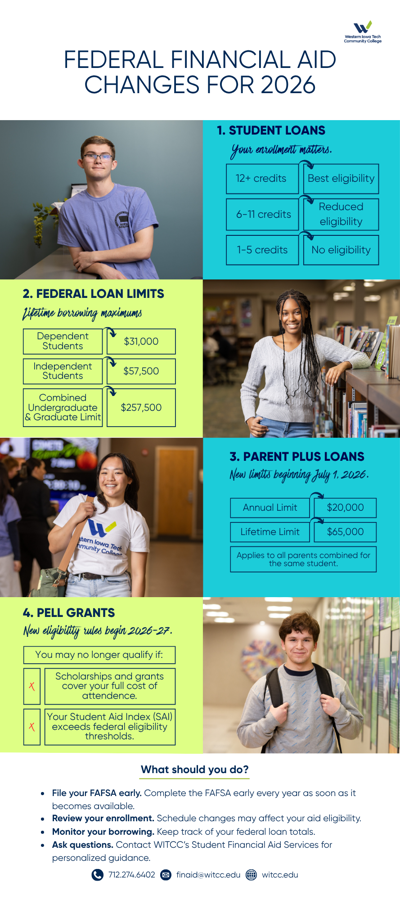
Loan eligibility will be based on your enrollment level.
Students enrolled in 12 or more credits per semester will be eligible to receive up to 50% of their annual federal loan limit each semester.
Students enrolled in fewer than 12 credits may see significantly reduced loan eligibility, and students enrolled in 1–5 credits will not be eligible for federal student loans.
People are also reading…
Your loan eligibility is determined by your enrollment at the time your loan is disbursed. Adding, dropping, or withdrawing from courses may affect your aid and could require repayment of a portion of your loan.
Federal student loan lifetime limits
Federal student loans remain subject to aggregate borrowing limits:
- Dependent undergraduate students: $31,000
- Independent undergraduate students: $57,500
- New combined undergraduate and graduate lifetime limit: $257,500
The new lifetime limit includes all federal student loans borrowed and applies regardless of whether previous loans were repaid, forgiven, canceled, or discharged.
Parent PLUS Loan changes
Beginning July 1, 2026, Parent PLUS Loans will be subject to new borrowing limits:
- Annual limit: $20,000 per dependent student
- Lifetime limit: $65,000 per dependent student
These limits apply to the combined borrowing of all parents for the same student. Families who have previously relied on Parent PLUS Loans to cover remaining educational costs may want to plan for these changes.
Federal Pell Grant changes
Beginning with the 2026–2027 award year:
- Students whose scholarships and grants fully cover their Cost of Attendance will no longer qualify for a Federal Pell Grant.
- Students with a Student Aid Index (SAI) equal to or greater than twice the maximum Pell Grant award may not be eligible for Pell funding.
What you should do
To prepare for these changes, we encourage you to:
- Complete the FAFSA as early as possible each year.
- Review your enrollment status before making schedule changes.
- Monitor your total federal loan borrowing.
- Contact the Financial Aid Office if you receive significant scholarship funding or have questions about your aid eligibility.
The Financial Aid Office is here to help you understand how these changes may impact your individual situation and assist you with planning for future semesters.